Behind the Mask – I AM; An Encounter Into the Mystery of Your Better Self

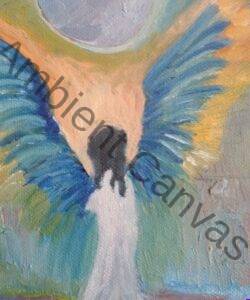
Behind the Mask – I Am is an original 40-by-30-inch painting created by layering oil on acrylic on canvas. Notwithstanding, just as the mixed medium, rather than prescribing a single interpretation, the work opens a reflective space around identity and the ways it may be encountered. Its stated subject invites attention to the distinction between a public self, shaped through interaction, and a more private awareness that can remain less visible in everyday life.
It is not to say that the mask is who I am. But rather, the I AM is what you don’t see behind the mask. In essence, at the heart of this encounter is a question: who are we when roles, defenses, and carefully maintained impressions no longer define us? Who are we, really, when we are left alone with ourselves? In the darkest recesses of our private closet, what self-identity do we honestly identify with? Being truthful within ourselves can help us navigate relationships and expectations. Yet this does not tell the whole story of our inner lives at all.
Behind The Mask – I AM Appearance
Looking beyond appearance, Behind the Mask – I AM does not require rejecting those roles; it means considering what they reveal. Indeed, what they conceal, and how much of our sense of self rests on them. How much is the life we have created around us pulling us away from who we truly came into this world to become? In the eyes of the artist, the soul of every individual can never become its true I AM self while allowing society to make of it what it demands of us to become.
The title’s simple declaration, “I AM,” points toward presence and being, while also leaving room for uncertainty. It may prompt viewers to ask what remains when familiar labels fall away, and whether the self is fixed or continually understood through experience. In this sense, the painting offers no ready-made answer. It encourages a slower kind of attention, allowing each person to bring their own questions about identity, privacy, and recognition.
The Work Behind The I AM
Encountering the work can therefore become an invitation to look beyond the facade without assuming that a hidden identity must be uncovered. The true self may be less a secret to solve than a relationship to examine: how we understand ourselves, how we meet others, and where those perspectives differ. By placing this inquiry at the center, Behind the Mask – I AM asks viewers to pause with the space between appearance and inward experience. Furthermore, to consider what “I AM” means to simply being. Observe the art piece, and you’ll notice that the figure is pointing to the heart, the center of self. The center where “I AM” resides.
The Meaning Behind “I AM”
The words “I AM” seem almost too simple to carry much meaning. Yet they name the most immediate fact of experience: before a person is a parent, professional, friend, or stranger, that person exists. Before we ever started this physical experience- we existed.
The phrase I AM does not explain who someone is; it marks the ground from which any description begins. In this sense, “I AM” is neither a boast nor a complete definition. It is an opening, directing attention to presence itself, before biography and judgment shape its meaning. That quiet recognition can make identity feel less fixed and more spacious, without making it unreal. Indeed, without limiting our fullness of capacity that we all carry within us.
“I AM! That, I AM!”
In philosophical and spiritual traditions, “I am that I am” has been read in different ways, but its force can be felt without settling on one doctrine. It invites a person to notice the bare experience of being, rather than immediately adding a role or explanation. A title at work, a reputation among friends, a temperament, or a history may describe important parts of life; none can contain the whole of the one who lives it. Even self-descriptions, though useful, are selective. They turn a changing inner life into names that can be shared, but neither names nor titles accurately point toward experiences.
Behind the Mask – I AM Not Visible
The artwork’s mask makes this distinction visible. A face, costume, or expression can suggest how someone appears to others, while also concealing what cannot be readily seen. Not by others for certain, but often not by ourselves, either. Looking behind the facade does not necessarily reveal a single, final identity waiting to be named. Instead, it may deepen the sense that each person carries an inward life that exceeds both public labels and private assumptions. The true self, in this view, is not another role to adopt or a perfect description to discover. It is the living presence that remains difficult to capture, even as people come to discover who they truly are.
Behind the Mask – I AM A Presentation
In everyday life, people often adjust how they present themselves to meet the expectations of a particular setting. At work, someone may adopt the polished professional: composed, prepared, and careful not to reveal uncertainty. Among friends, the same person might become the agreeable listener, smoothing over differences to preserve closeness. Others emphasize confidence when leading a team. Maybe even while privately questioning their decisions. These social masks are not necessarily deliberate attempts to mislead. They can develop as practical responses to environments where approval, safety, or opportunity seems tied to a particular kind of behavior.
A facade can help people navigate relationships and responsibilities. Professional restraint may keep a tense meeting productive; friendliness can ease an unfamiliar encounter; confidence may reassure people who depend on a leader. Such roles offer protection when vulnerability feels risky, and they can provide a useful structure for acting under pressure. A person may discover that a certain manner earns trust or avoids conflict, then rely on it repeatedly. In this sense, the mask is often an adaptation shaped by experience, not proof that someone lacks sincerity or has no stable identity beneath the performance.
In Conclusion
Because the ego is concerned with self-image, it often seeks recognition and a measure of control. It may ask whether others approve. Whether we appear capable, or how our lives compare with theirs. Such concerns are ordinary, not signs of a false or defective self. Social identity matters, and belonging to families, communities, and professions can be meaningful. The difficulty arises when the public account becomes so convincing that we mistake it for everything we are.